The Staircase Potrero Hill Had to Build Itself
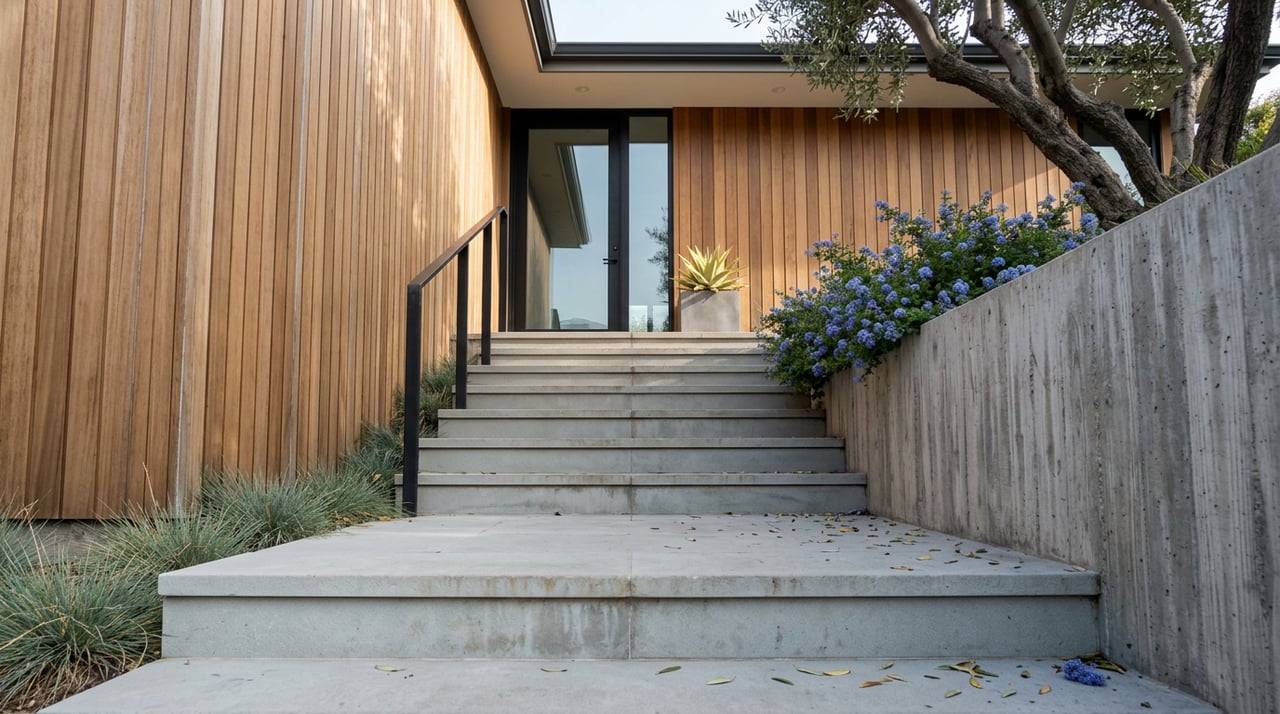
Walk north from the Potrero Hill Recreation Center along 22nd Street and the sidewalk gives out. What's left is a rocky, sourgrass-choked path that drops at a 26 percent grade toward Missouri Street, no lights, no rail, loose gravel underfoot. Keep going past Missouri and the route splits: one branch runs down toward Texas Street, where it dead-ends mid-block at a chain-link fence next to a 256-unit apartment building called The Landing. On the other side of that fence is a finished staircase. On this side is dirt.
That fence is the detail worth sitting with, because it says something about how Potrero Hill actually gets civic infrastructure built. This particular gap in the hillside has been promised, planned, and partially funded since 2015. What finally got a shovel in the ground in 2026 was not the piece a developer was legally obligated to build. It was the piece the neighborhood had to invent its own funding coalition to pay for.
The story starts with The Landing itself. When the 256-unit complex at 1395 22nd Street went through entitlement in 2015, its developer, Sherman Little, agreed to build a 181-step public staircase across roughly 6,300 square feet of the site, running from 22nd and Texas up to Missouri Street. Local reporting at the time called it the "Serpentine Steps," a nod to the vein of serpentine rock the route would follow. In exchange, the project won a key exemption from having to complete a detailed environmental impact report under the city's Eastern Neighborhoods rezoning.
That's a real trade: the developer got a faster, cheaper path to approval, and the neighborhood got, on paper, a public amenity. Later that same year, Little sold the project to Align Real Estate. The Landing opened in 2019. The staircase did not open with it. In a letter to Dogpatch Neighborhood Association member Katherine Doumani that year, Align's principal, Julian Marsh, wrote that the company was eager to finish the last stretch but was waiting on a major encroachment permit from the city.
By 2023, residents were publicly calling on the city and the developer to finish what had been promised eight years earlier. The abbreviated stairway at 22nd and Texas still ran past The Landing and stopped at a pile of dirt, unconnected to Missouri Street. Julie Christensen, executive director of the Dogpatch and Northwest Potrero Hill Green Benefit District, put the underlying problem plainly at the time, arguing that the city treats community amenities as something residents have to chase down themselves rather than something it funds directly.
By February 2026, the San Francisco Chronicle was still describing this segment as unfinished after ten years, noting that residents duck through a hole in the fence and scramble up the slope rather than wait. Dogpatch Neighborhood Association member Katherine Doumani had a name for it by then: "a staircase to nowhere."
While the developer-obligated segment sat behind its fence, a different piece of the same hillside started moving, and it moved because a hospital system needed somewhere to spend money.
Friends of the Potrero Hill Recreation Center, a resident-led group operating under the Green Benefit District's fiscal sponsorship, had been planning a separate connector since 2015: a set of trail steps replacing the steep dirt path between Missouri and Connecticut streets, just north of the Rec Center itself. Hill resident Jennifer Serwer, who runs the design firm Hibiscus Studio, worked pro bono on early designs. In 2017, after an eight-month internal review, UCSF committed $500,000 to the project, tying the funding to the university's own expansion into Dogpatch, including student housing on Minnesota Street and a psychiatry center on Third Street. The Mayor's Office of Housing and Community Development added a $102,000 planning grant.
None of that money came from a permit condition. It came because UCSF needed what its own staff called a "nexus" between the staircase and the university's presence in the neighborhood, and because a handful of residents kept the project alive long enough for that nexus to matter. By late 2025, the funding stack for this segment included not just the UCSF grant but $27,500 from the Power Station Foundation, another $27,500 from Hill residents Keith Goldstein and Donna Warrington, and $5,000 from Russell Simmons, on top of smaller neighbor donations. Construction was slated to begin that winter. This year, Lanier Construction started building it.
Here's the table, laid out plainly, because the sequence matters more than any single date in it:
| When | What happened |
|---|---|
| 2015 | The Landing's developer agrees to build a 181-step staircase from Texas to Missouri Street as a permit condition, then sells the project to Align Real Estate. |
| 2017 | UCSF commits $500,000 to a separate segment, Missouri to Connecticut, unconnected to any permit obligation. |
| 2019 | The Landing opens. Its promised staircase segment does not. |
| 2023 | Residents publicly press the city and Align to finish the Texas-to-Missouri segment, still fenced off. |
| Winter 2025-26 | Construction begins on the UCSF-funded Missouri-to-Connecticut segment. |
| February 2026 | The San Francisco Chronicle reports the Texas-to-Missouri segment still dead-ends at a fence after a decade. |
| 2026 | Lanier Construction is actively building the Missouri-to-Connecticut steps. |
Read across that table and the pattern is hard to miss. The obligation with legal teeth, the one attached to an entitlement and a signed agreement, is the one still stuck. The obligation nobody owed the neighborhood anything on is the one that got built.
None of this changes the basics of daily life on the Hill today. You still walk down to 18th Street for coffee, still cut through the Rec Center's eleven acres of ballfields and dog run, still catch the T line down at the bottom of the hill if you're headed to the waterfront. But the finished Missouri-to-Connecticut steps will do something specific once they're done: they'll give Dogpatch residents a real walking connection up to the library, the Rec Center's gym and courts, and the shops along 18th and 20th streets, without cutting through a dirt slope that's already caused at least two neighbors to slip and injure themselves, according to Friends of Potrero Hill Recreation Center co-director Jennifer Serwer.
The Texas-to-Missouri piece, the one still behind the fence as of the Chronicle's February reporting, is the one that would complete the connection all the way down to the 22nd Street Caltrain station. Until that section moves, the hillside link from Dogpatch to Potrero Hill stays broken in the middle, no matter how good the new steps above it look.
There's a version of this story that's just about a staircase. The more useful version, if you live on the Hill, is a small case study in where to direct your attention when you want something in this neighborhood to actually happen. It's rarely City Hall that closes the gap first. It's the Green Benefit District, the Friends of Potrero Hill Recreation Center, the Potrero Boosters, a university with its own reasons to say yes, and residents willing to write letters for a decade. J.R. Eppler, president of the Potrero Boosters, has said as much about the working relationship between Rec and Park staff, DPW, and the neighborhood group on this exact project: the coordination that gets something built here tends to run through those channels first, city departments second.
If you want to see how that same civic muscle shows up outside of infrastructure fights, the Potrero Hill Festival returns for its 51st year on Saturday, October 17, starting at 10 a.m., stretched across four blocks of 20th Street between Wisconsin and Missouri. It's organized in part by the Potrero Hill Neighborhood House, and proceeds go toward Daniel Webster and Starr King Elementary Schools and the Nabe's after-school programs. Same neighborhood instinct as the staircase story: when something needs doing here, the people who live here tend to be the ones who do it.
If you're a Potrero Hill property owner weighing whether now's the time to lease, renovate, or bring in additional management support, Ray Amouzandeh has spent years tracking exactly this kind of neighborhood-level detail, the sort that doesn't show up in a median-price chart but shapes what a property is actually worth living near. Get a fast leasing plan, schedule a free consultation, and find out what's changing on your block before your next tenant does.

We represent many of the best apartments, condominiums, and single-family rental homes throughout the city, specializing in sought-after communities in San Francisco. Contact us today to find out how we can be of assistance to you!